One view of Wright of Derby: From the Shadows, at the National Gallery, London
We can only dream of a world in which light is as precious as it is to the figures in Joseph Wright’s most celebrated paintings. The small groups of the curious clustered around the orrery, or the air pump, are a century away from electric lighting, the land around them still drowned by night.

Although not in the exhibition, Wright portrayed Erasmus Darwin, one of the founding members of the Lunar Society of Birmingham, self-described “lunaticks” who time their meetings to the full moon, when it is safer to travel across that sea of darkness. The men, women and children in Wright’s paintings are also travelling – not just through space, to a meeting of minds in Handsworth, but through time, to join us in the modern world.
Their lives are not so far from ours. At that moment in history the Scientific Revolution is a century behind them, the Industrial Revolution that Wright puts to painting will flood the skies with light. On the eve of World War I, E. E. Barnard explained how “[t]he great cities that have grown up since 1835, and the smoke and electric lights of today completely robbed [Halley’s] comet of its glory when seen by dwellers in and near the centers of population.” Little by little the territory of night was being lost.
The only way that most people would ever see those stars again was in the successor to the orrery portrayed in Wright’s painting – the planetarium, the first of which opened in 1925 at the Deutsches Museum in Munich. As so often with a problem caused by technology, technology provided a solution. The Zeiss company had initially been approached by Oskar von Miller, founding director of the museum, in 1913, but it had taken a decade of work to make this miracle. Unlike Wright’s orrery, in which a lamp is put in place of the sun, the centrepiece of the planetarium was the Zeiss Model I Projector.
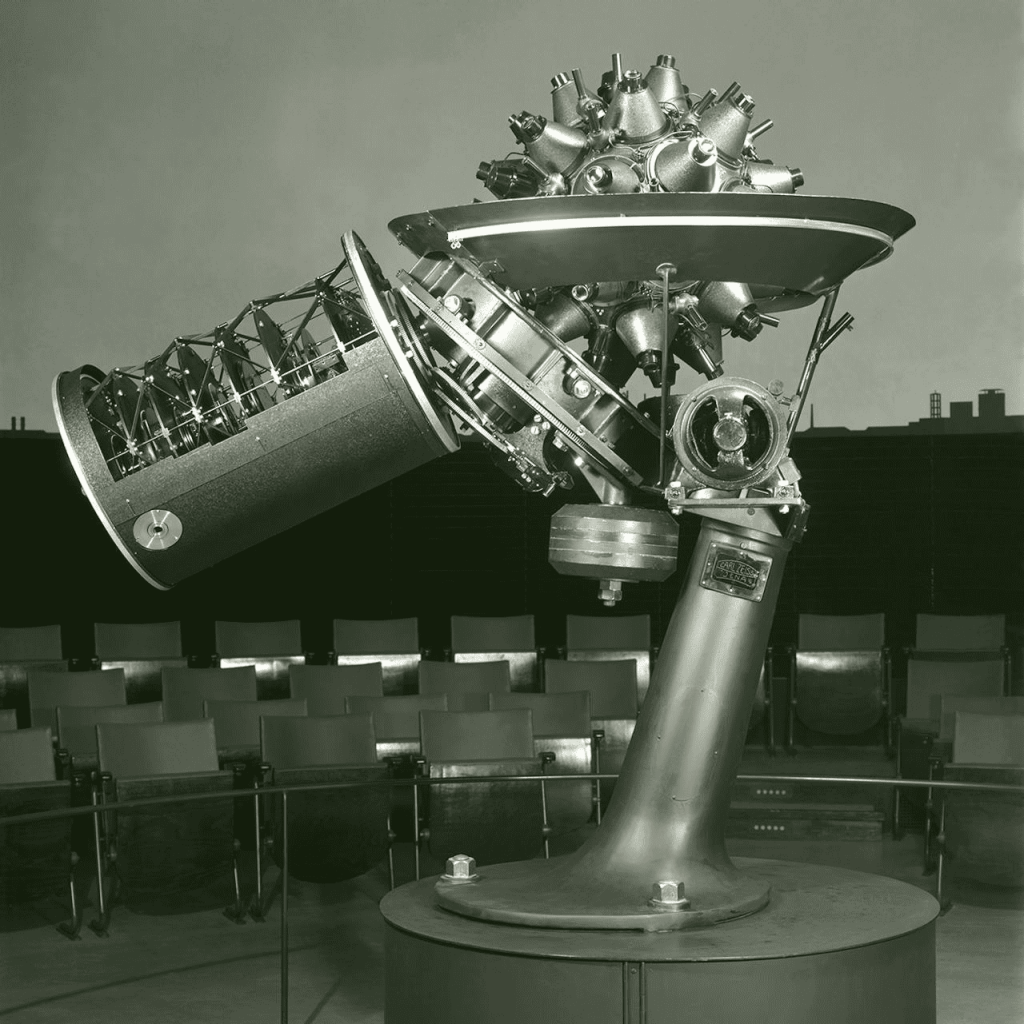
Von Miller had in 1882 organised the first German Electricity Exhibition, later writing that the exhibition “gave the electricity industry an opportunity to publicize its achievements, but above all familiarized visitors with those new achievements, through a particularly instructive presentation,” so it would be more accurate to say that industry provided a solution. Fast forward a century, and Zeiss remains the leading provider of planetarium projectors, while the instructive presentations continue.
In June 2024 the planetarium hosted the launch event of a project called “Space Trash Signs: Understanding Space Pollution”. As well as more than 10,000 functioning satellites labouring in the thermosphere, there are millions of pieces of space debris whistling around, making low earth orbit a more dangerous place to be than the inside of an air pump. For those of us living beneath this metastasizing empire of metal, the loss of night sky can lead to insomnia, obesity, and depression.
250 years earlier, The Earthstopper on the Banks of the Derwent fills in foxholes by the luxuriant light of his lamp, while the moon haunts the treeline behind him. Once again Wright’s sympathies lie with light made by human hands, but once again the moon itself is full to allow our earthstopper to find his way home. Meanwhile in The Blacksmith’s Shop, the brightest light shines proud from metal from the forge, not from the pale moon which winks shy from behind clouds. Whether by candle, lamp or forge, Wright’s light is a prize which has been won, not a gift that has been given.

When we stand in front of his paintings we might be moved not just by admiration of Wright’s craft, substantial though it was, but by envy of the people in those paintings. The world they lived in was darker than ours, but they still had enough light to see by, and the promise of a brighter world to come. We are not so lucky, I think; we live in the brilliant world, but a little darkness might allow our eyes to recover enough to see the miracles of that world more clearly.